2+ Years Live · 1M+ Units a Year · FSMA 204 Ready

See the shrink the day it happens.
The execution layer for institutional food — alongside your ERP.

Shrink Manager™ captures daily production work as structured data — so shrink analytics, FSMA 204 traceability, and audit-ready records emerge automatically.

Deployed across multi-site production environments. Sits alongside your ERP — no replatforming.
See it. ID it. Target it. Prevent it. shrink by site, product, shift, and SKU — the same day it happens
10+
Production Sites Live
1M+
Units Captured a Year
2+ Yrs
Live Operational Data
FSMA 204
Audit-Ready Workflows
Currently deployed across 10 production sites within a single affiliated operator. Commercial launch underway ahead of FSMA 204
Those kitchens supply
🏥
Hospital Systems
🎓
Sodexo Accounts
🍽️
Aramark Partners
🏛️
University Dining
🏢
Corporate Dining
🔒 app.shrinksoftware.com/dashboard
Operations Dashboard
Orders Today
By site and product
Shrink Rate
Same-day, by SKU
CTEs Captured
Receiving · transform · ship
Invoiced (MTD)
From completed orders
Recent Production Orders
Auto-synced
LocationProductProducedShrinkCTE StatusStatus
Kitchen — Site AFresh Protein BowlAuto-capturedDelivered
Kitchen — Site BGarden Salad KitAuto-capturedReview
Kitchen — Site CGrain & Veggie BowlAuto-capturedDelivered
Kitchen — Site DFresh Wrap EntréeAuto-capturedIn Transit
Illustrative interface. Live figures are specific to each operation — request a demo to see real data.
10+
Production Sites
1M+
Annual Units
2yr
Live in Production
3
CTEs Auto-Captured
12
Patents Pending
We implemented NetSuite for $80,000. It couldn't tell us our shrink rate. So we built the tool we actually needed, inside our own production kitchens.
BO
Dr. Bradley Oostindie
Co-Founder, Shrink Software
Built From the Inside

Operators built this for themselves first

Shrink Manager was developed inside Anu Sushi LLC, an affiliated multi-site institutional food manufacturer supplying hospitals, universities, and corporate dining through Sodexo and Aramark. Every gap this platform fills, the founders hit first.

🏭
Built in live production
Every feature tested across 10 active sites before commercialization. Two-plus years of real shrink and order data, not simulations.
📊
The records are the work
Compliance and shrink analytics come from the same event capture, generated as a byproduct of normal operations.
🔒
Defensible by design
Twelve USPTO provisional patents filed on the workflow logic that took years of operational iteration to develop.
The Economics

Don't scale the bureaucracy.
Scale the operating system.

As fresh-food companies add sites, customers and production volume, administrative complexity tends to grow with them. More reconciliation. More compliance work. More people assembling information from operations. Shrink Manager captures structured data as the work happens, so growth does not have to create administrative overhead at the same rate.

Product shrink is visible. Operational shrink is harder to see.
Time disappears into duplicate entry
The same numbers are keyed into a production sheet, then a spreadsheet, then an invoice — each one a chance to be wrong.
Managers chase missing information
Someone spends the morning working out what happened yesterday instead of deciding what happens today.
Compliance records are assembled after the fact
Work that was already done gets written up a second time, from memory, to satisfy an audit.
Accounting reconciles what operations already performed
The delivery happened and was recorded. The invoice gets built again from scratch.
📐 Shrink Manager is built to reduce both kinds — the product you made but never sold, and the administrative work that grows every time you add a site.
The Idea

Shrink is not a reporting problem.
It's an operational decision problem.

FSMA 204 is what starts the conversation. The same daily capture is what keeps it going, because it also tells you what to make tomorrow. Four rungs, each one worth more than the last.

01
"We need to comply with FSMA 204."
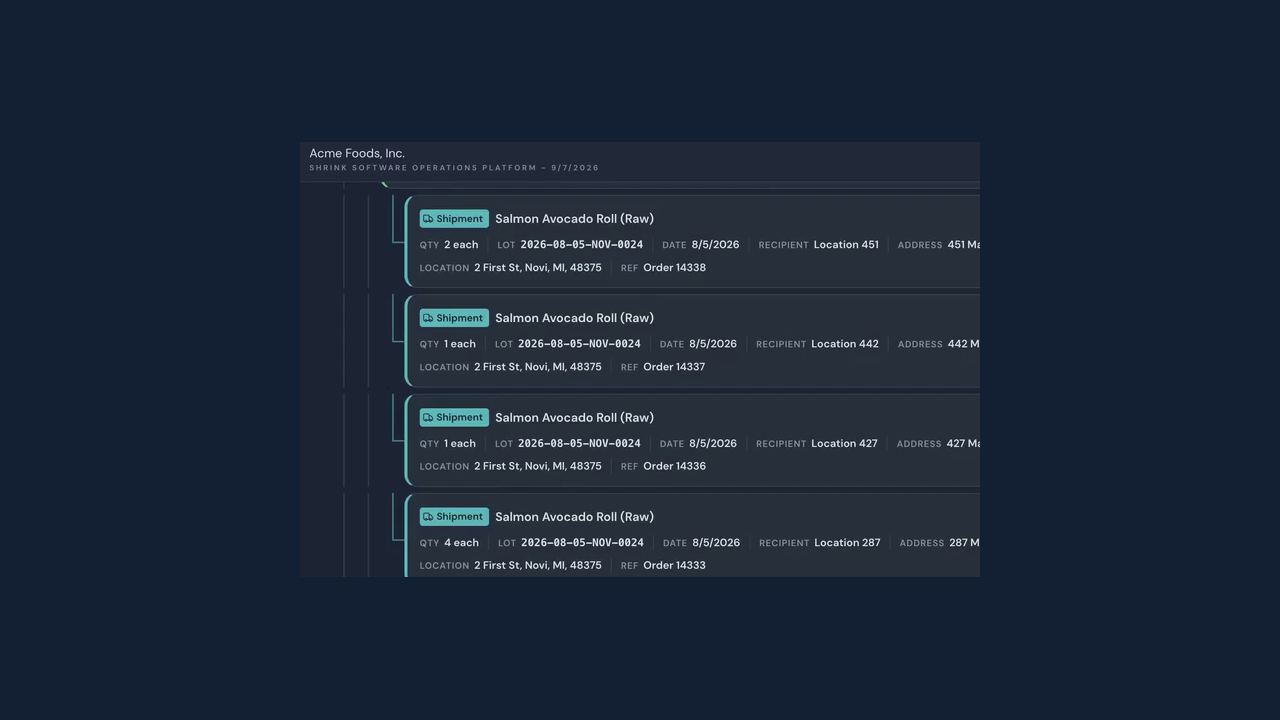
Lot-level receiving, transformation, and shipping records captured at the point of work. Audit-ready on demand.
Comply
02
"Now we can see what's happening."
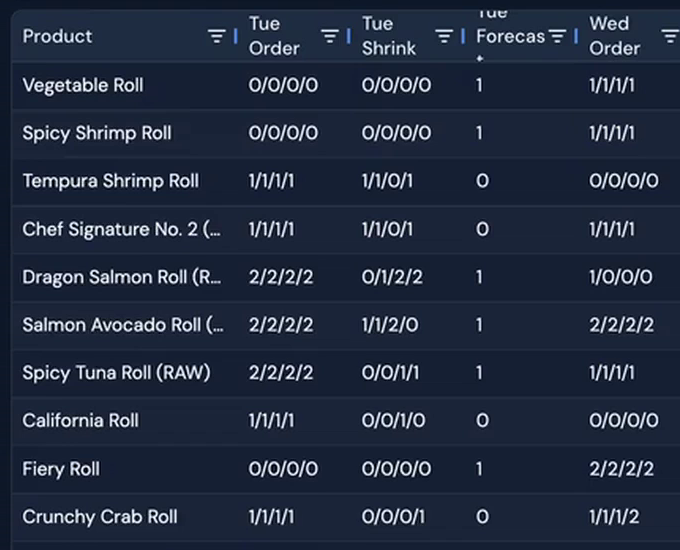
Produced, sold, and shrink visible in real time, at the line, by site and product, instead of weeks later at month-end.
See
03
"Now we know where the shrink is."
The produced-vs-sold gap broken out by site, product, day, shift, and SKU. The obvious sources of loss stop being invisible.
Understand
04
"Now we know what to produce tomorrow."
The gap feeds the next order. The forecast tightens, and the margin that used to expire in the walk-in has a chance to stay in the business.
Decide
Those four are what Shrink Manager does today. What the same architecture makes possible — routine work handled without intervention, and patterns across sites that no single location can see — is on the Technology page.
The Produced-vs-Sold Loop

Know what to produce tomorrow.

The largest and most addressable shrink is the gap between what you made and what you sold. Capture three numbers at the order level every day, and close it.

Produced
What you made
Production captured at the order level, at the point of work, by the operator doing it.
Sold
What demand took
Delivery and sell-through recorded against the same order, the same day. The same capture produces the invoice.
Expired
The gap
Product made but never sold. The over-portioned run, the batch that outran its orders, the tray that aged out.
🔄 Feed the gap into the next production order. The forecast tightens. The loop closes without anyone re-entering anything.
Production shrink is the gap between what you made and what you sold. See it the same day — by site, product, shift, and SKU — then feed it straight into the next order. Because the delivery record is also the invoice, the data arrives as part of getting paid rather than as an extra step someone has to remember.
Built For

Is this your operation?

Purpose-built for institutional fresh food manufacturers producing high-volume, perishable product for managed dining accounts.

🍱
Multi-Site Fresh Food Manufacturers
Daily production for hospital, university, or corporate dining across 2 to 10 sites. Real-time visibility into production, waste, and margin.
SushiSaladsMeal prepPrepared foods
🏥
Hospital & University Food Ops
In-house kitchens with strict compliance and institutional buyers demanding traceability on demand.
Health systemsCommissariesSodexoAramark
🤝
Franchise & Commissary Networks
Central kitchen plus franchise distribution, the exact architecture Shrink Manager was built on.
Central hubsFranchisorsGhost kitchens
In Production Today

What the capture actually produces

Two-plus years of continuous production across 10 sites operated by Anu Sushi LLC, an affiliated operator. Figures below describe what the platform captures, not a published performance result.

1M+
Units Captured AnnuallyEvery production order recorded as a structured event across 10+ sites
Same day
Shrink VisibilityProduced-vs-sold gap broken out by site, product, shift and SKU
1 role
A/R EliminatedInvoicing runs off completed production orders instead of manual entry
3 CTEs
Auto-CapturedReceiving, transformation and shipping recorded at the point of work
Why Now

FSMA 204 opens the door.
Shrink keeps it open.

FSMA 204 is the catalyst. It creates urgency, budget, and executive attention, and pulls operators into the market now. The FDA deadline is July 20, 2028. Your buyers' deadline is earlier: major distributors and retailers are already requiring traceability data from suppliers — Walmart's supplier requirement took effect in August 2025.

Compliance budgets come and go. Shrink budgets never go away. The same daily capture that produces your audit records closes the produced-vs-sold loop — so the system earns its keep after the deadline passes, not just before it.

If you are about to spend money on FSMA 204, spend it on a system where the same capture also shows you your shrink.
3
CTEs captured at the point of work
24 hr
FDA record request window
Jul '28
FDA deadline
2022–2024
FSMA 204 Rule Finalized
FDA finalizes the Food Traceability Rule for foods on the Food Traceability List. Records may be kept on paper or electronically.
!
Now
Buyer Requirements Begin
Major distributors and retailers are requiring traceability data from suppliers ahead of FDA enforcement. Walmart's requirement — advance shipment notifications carrying key data elements, with SSCC-18 pallet labels — took effect in August 2025.
July 20, 2028
FDA Enforcement Begins
Covered operators must produce required traceability records within 24 hours of an FDA request, or a longer period FDA agrees to.
⚠️
Operators who start now build an operational data history
Those implementing later face a compressed timeline with no baseline to compare against and no history to audit from.
Works With ERP

Alongside ERP.
Not a spreadsheet.

Enterprise software runs the back office of food operations beautifully. The production floor is a different problem. ERP is forward planning. Compliance binders are an after-the-fact rear-view mirror. Neither one runs the shift.

After a failed NetSuite implementation, we built the missing layer: the compliance and execution work that happens in the present tense, between the production order and the financial system.

Your financial system stays untouched. No replatform.

Pair Shrink Manager with the accounting you already run. See the full comparison →
Built for the floor, not the back office
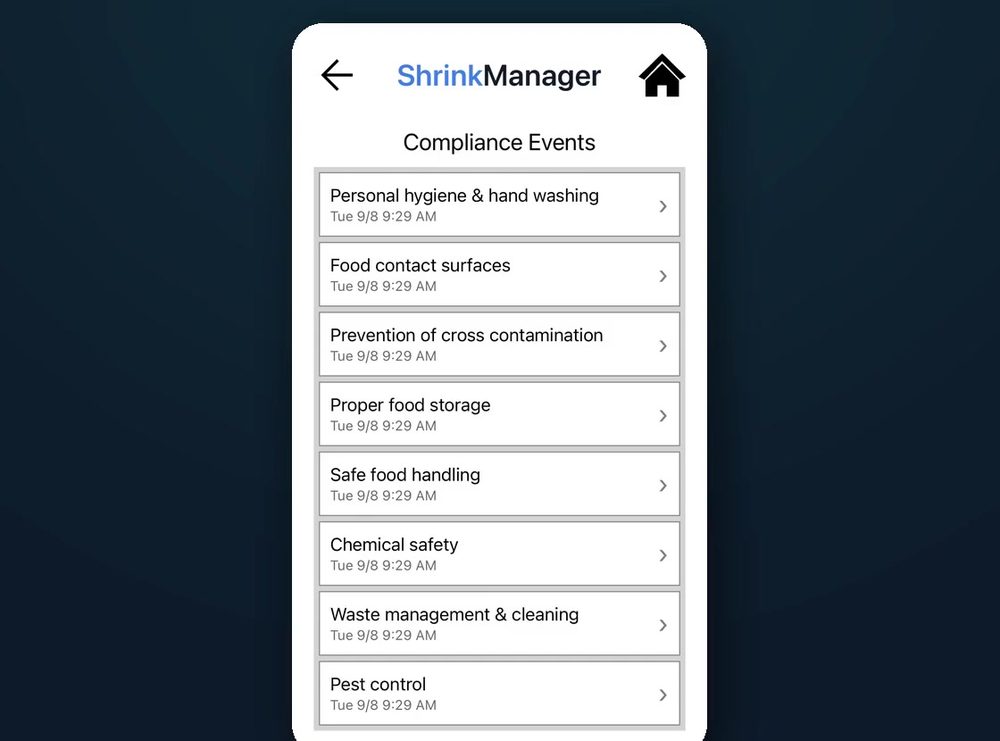
Temperature logs, receiving records, pH monitoring, and cooling documentation, digitized and enforced at the point of work.
Compliance that builds itself
Documentation is generated as your team does the job, not assembled by hand afterward.
Gated at the control point
A worker cannot move past a control point until the required record exists, and an ingredient with no lot behind it cannot be selected at all. The record is a condition of doing the work.
One-click FDA-ready reports
Traceability records generate instantly — timestamped, structured, and exportable as the sortable electronic spreadsheet FDA may request.
Order-to-invoice automation
Delivery confirmed in the platform creates the QuickBooks invoice automatically. No manual reconciliation.
See it in your operation.

We're commercializing beyond the operation this was built in — starting with operators who need compliance and cost visibility now.

We respond within one business day.
No long-term contract required